
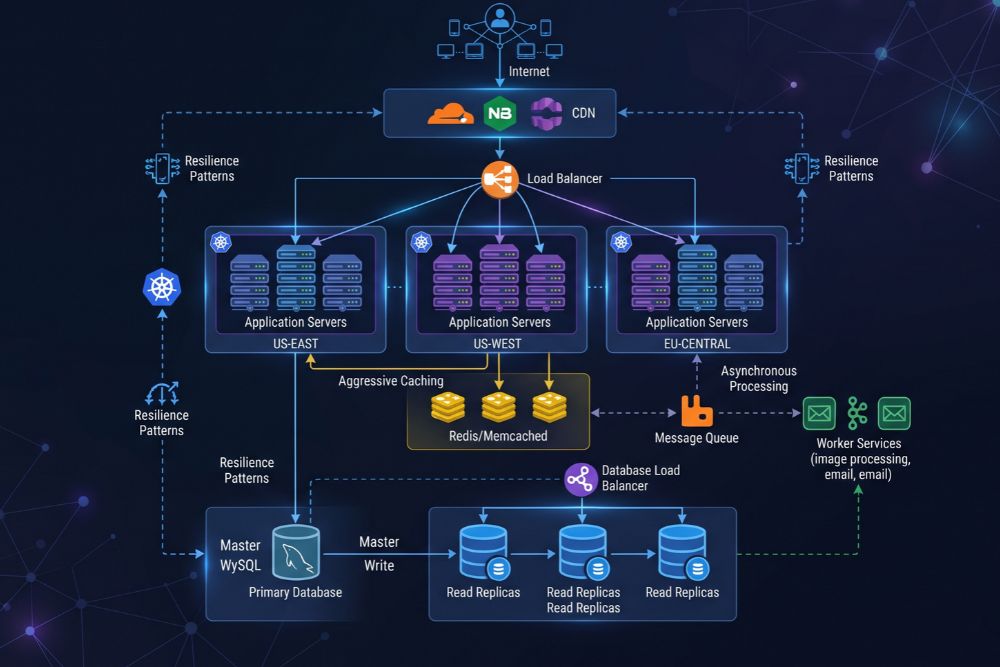
Scalable system design is the difference between a platform that thrives on launch day and one that collapses under its own success. One viral post, one flash sale, one feature on a big news site, and traffic can jump 10x in minutes. If your architecture isn’t ready, users don’t wait around. They leave.
Google research has shown that 53% of mobile visits are abandoned when a page takes longer than three seconds to load. For high-traffic platforms, that means slow equals lost revenue, lost trust, and lost rankings.
In this guide, you’ll learn 9 proven strategies for scalable system design, a simple vertical vs horizontal scaling comparison, the costly mistakes to avoid, and a quick checklist you can use today. Whether you run a WordPress site, an e-commerce store, or a custom web app, these principles will help you grow without breaking.
What Is Scalable System Design and Why Does It Matter?

Scalable system design is the practice of building software and infrastructure that can handle growing traffic, data, and users without a drop in speed, reliability, or user experience, and without a full rewrite every time you grow.
A truly scalable system does three things well:
- Handles growth: performance stays stable as users, requests, and data increase.
- Stays available: a single server or service failure never takes the whole platform down.
- Controls cost: you add capacity only when you need it, and remove it when you don’t.
The earlier you apply scalable system design principles, the cheaper they are. Retrofitting scalability into a platform that’s already struggling is stressful, expensive, and risky.
9 Proven Strategies for Scalable System Design

1. Build Stateless Services
A stateless service doesn’t store user session data on its own server. Every request carries what it needs, or fetches it from a shared store like Redis. That means any server can handle any request, which makes adding or removing servers effortless.
This is the foundation of scalable system design. If your sessions are stuck on one machine, you can’t scale horizontally.
2. Put a Load Balancer in Front of Everything
A load balancer distributes incoming traffic across multiple servers so that no single machine gets overwhelmed. It also runs health checks and automatically stops sending traffic to servers that fail.
- Round robin: simple, even distribution for similar servers.
- Least connections: sends traffic to the least busy server.
- IP hash: keeps a user on the same server when you need stickiness.
Tools like NGINX, HAProxy, and cloud-native load balancers from AWS, Google Cloud, and Azure make this easy to set up.
3. Cache Aggressively, Cache Smartly
The fastest request is the one your database never sees. Caching is one of the most powerful and cost-effective tools in scalable system design. Use it at multiple layers:
- Browser cache: store static files on the user’s device.
- Application cache: keep hot data in Redis or Memcached.
- Page and object cache: serve fully rendered pages without hitting your backend.
Just remember the golden rule: cache invalidation is hard. Set sensible expiry times (TTL) and decide up front how stale data is allowed to be.
4. Scale Your Database the Right Way
For most platforms, the database becomes the first real bottleneck. Here’s the proven path to scale it:
- Optimize first: add proper indexes, fix slow queries, and avoid N+1 query patterns.
- Read replicas: send read traffic to copies and keep the primary for writes.
- Sharding: split data across multiple databases by a key such as user ID or region.
- Right tool for the job: use NoSQL or search engines for workloads that don’t suit a relational model.
Don’t jump straight to sharding. It adds real complexity. Squeeze every bit of performance from optimization and replicas before you split your data.
5. Go Asynchronous With Message Queues
Not everything has to happen while the user waits. Sending emails, resizing images, generating reports, and syncing data can all be pushed to a background queue using tools like RabbitMQ, Apache Kafka, or Amazon SQS.
This approach smooths out traffic spikes, keeps response times fast, and prevents one slow task from dragging down your entire platform.
6. Use a CDN for Static and Edge Content
A Content Delivery Network (CDN) stores copies of your images, scripts, and stylesheets on servers around the world. Users get content from the location closest to them, which cuts latency and takes a huge load off your origin server.
For global audiences, a CDN is one of the quickest wins in scalable system design. It also improves Core Web Vitals, which helps your SEO.
7. Design for Failure With Resilience Patterns
At scale, something is always failing. The goal of scalable system design isn’t to prevent every failure. It’s to survive them gracefully. Build in these safeguards:
- Timeouts and retries: never let a request hang forever, and retry with exponential backoff.
- Circuit breakers: stop calling a failing service so it can recover.
- Rate limiting: protect your APIs from abuse and sudden floods.
- Graceful degradation: if recommendations fail, still show the product page.
8. Monitor Everything and Auto-Scale
You can’t scale what you can’t see. Track the essentials: response time, error rate, CPU and memory usage, queue length, and database connections. Tools like Prometheus, Grafana, Datadog, and New Relic give you the visibility you need.
Then connect those metrics to auto-scaling rules, so your platform adds servers during peak hours and scales back down at night. You get performance when you need it and savings when you don’t.
9. Load Test Before Real Traffic Does
Never let your users be your load test. Use tools like k6, JMeter, or Locust to simulate traffic spikes before launch, a marketing campaign, or a sale. Test for:
- Your breaking point (how many users before things slow down?).
- Which component fails first (database, cache, or API?).
- How fast the system recovers once the load drops.
Run these tests regularly, not just once. Every new feature changes how your system behaves under pressure.
How to Choose the Right Scalable System Design for Your Business
Choosing the right scalable system design depends on your business goals, current infrastructure, expected traffic, and long-term growth plans. Not every website or application needs a complex architecture from the beginning. The key is to build a system that meets today’s requirements while leaving enough room for tomorrow’s demands.
For a growing startup, a well-structured monolithic application with optimized database queries, caching, and a reliable hosting environment may be more than enough. As traffic increases, individual components can be upgraded or separated when performance data shows a genuine need. This avoids unnecessary development costs and keeps maintenance manageable.
For e-commerce businesses, scalability becomes particularly important during seasonal sales, promotional campaigns, and high-demand shopping periods. A combination of CDN delivery, application caching, database optimization, and load balancing helps maintain a smooth shopping experience even when thousands of customers browse products or complete transactions simultaneously.
Businesses operating SaaS platforms or enterprise applications may require a more distributed architecture. Separating services, introducing message queues, and implementing automated scaling can help different parts of the application grow independently without affecting the entire platform.
Before selecting an architecture, consider these important factors:
- Expected traffic: Estimate current users and potential traffic growth over the next 12–24 months.
- Application complexity: Identify whether your platform needs simple infrastructure or independently scalable services.
- Data requirements: Evaluate database size, read/write operations, backup strategies, and security.
- Budget: Balance infrastructure costs against performance, availability, and maintenance requirements.
- Future flexibility: Choose technologies and architecture patterns that allow upgrades without rebuilding everything.
Remember, the best architecture is not necessarily the most complicated one. It is the one that delivers consistent performance, supports business expansion, protects user data, and remains affordable to operate. By evaluating these factors early, you can create a strong technical foundation that supports sustainable growth without unnecessary complexity.
5 Common Scalable System Design Mistakes to Avoid
- Over-engineering too early: a startup with 1,000 users doesn’t need a 50-microservice setup. Scale as you grow, but design so you can.
- Ignoring the database: adding more app servers won’t help if every request still hits one overloaded database.
- Skipping monitoring: flying blind means you find problems when customers complain.
- Single points of failure: one server, one database, or one region can bring everything down.
- No load testing: assumptions are not benchmarks.
Quick Scalable System Design Checklist
Use this before your next big launch or traffic campaign:
- Are my services stateless and ready to scale horizontally?
- Is a load balancer distributing traffic with health checks enabled?
- Do I have caching at the browser, application, and page level?
- Have I optimized queries and set up read replicas?
- Are heavy tasks handled in background queues?
- Is a CDN serving my static assets?
- Do I have timeouts, retries, and rate limits in place?
- Are monitoring and auto-scaling configured?
- Have I load tested with realistic traffic?
Final Thoughts: Build for Growth From Day One

Great scalable system design isn’t about using the trendiest technology. It’s about making smart, simple decisions early: stay stateless, balance the load, cache wisely, scale your database carefully, process work asynchronously, and always plan for failure.
Start with the strategies that fix your biggest bottleneck today, measure the results, and keep improving. Your users, your search rankings, and your revenue will thank you.
At Panalinks, our team designs, builds, and optimizes fast, secure, and scalable websites and web platforms for growing businesses. From architecture planning and performance tuning to Core Web Vitals and technical SEO, we help you handle more traffic with confidence.
Get a free consultation today. Email us at contactus@panalinks.com