

Marketing data integration is the difference between guessing and growing. Yet in a 2024 BlueConic survey of 100 senior marketers, 72% said they struggle to integrate data from multiple sources and platforms.
Sound familiar? Google Ads says one thing, Meta says another, GA4 disagrees with both, and your CRM tells a completely different story. Every platform claims the credit, and none of them shows the full picture.
The good news: fixing it is easier than you think. This ultimate guide gives you a proven, step-by-step blueprint to connect your platforms and finally trust your numbers.
Here is what you will learn:
- What marketing data integration really means (in plain English)
- Why disconnected data quietly drains your budget
- 7 proven steps to unify your marketing data
- The best methods and tools, compared side by side
- 5 costly mistakes that derail integration projects
Let’s dive in.
What Is Marketing Data Integration?

Marketing data integration is the process of pulling data from every platform you market on, cleaning and standardizing it, and combining it into one trusted view. Instead of logging into a dozen dashboards, you see ads, analytics, CRM, email and sales data side by side.
Think of it as a translator. Google Ads calls it “cost,” Meta calls it “amount spent,” and your CRM calls it something else entirely. Integration makes them all speak the same language.
Most marketing teams pull from sources like these:
- Paid media: Google Ads, Meta Ads, LinkedIn Ads
- Web analytics: GA4, Google Tag Manager, Search Console
- CRM and sales: HubSpot, Salesforce, Zoho
- Email and automation: Mailchimp, Klaviyo, Brevo
- Ecommerce and payments: Shopify, WooCommerce, Stripe
Behind the scenes, every integration follows the same three stages:
- Extract: pull raw data from each platform through APIs or connectors.
- Transform: clean it, match field names, fix currencies and time zones.
- Load: send it to one destination, such as a data warehouse, dashboard or CRM.
The payoff is a single source of truth that powers reporting, attribution and automation, without a single copy-pasted spreadsheet.
Why Marketing Data Integration Matters More Than Ever

Disconnected data is not just annoying. It is expensive. A March 2025 MarketingProfs survey of 272 marketers found that 54% name disconnected platforms as one of their biggest data blockers.
And the price tag adds up. Gartner estimates that poor data quality costs organizations an average of $12.9 million every year. Siloed, mismatched marketing data is a major contributor.
Here are the 5 biggest wins you unlock once your marketing data is connected:
- Accurate attribution: see which channels truly drive revenue, not just clicks.
- Instant reporting: replace hours of manual exports with live dashboards.
- Smarter budget decisions: shift spend to what works while the campaign is still running.
- Powerful personalization: combine behavior, purchase and email data into one customer view.
- AI-ready data: clean, unified data is the fuel that predictive models and AI tools need.
In short, marketing data integration turns scattered numbers into decisions you can defend in any meeting.
7 Proven Steps to Master Marketing Data Integration
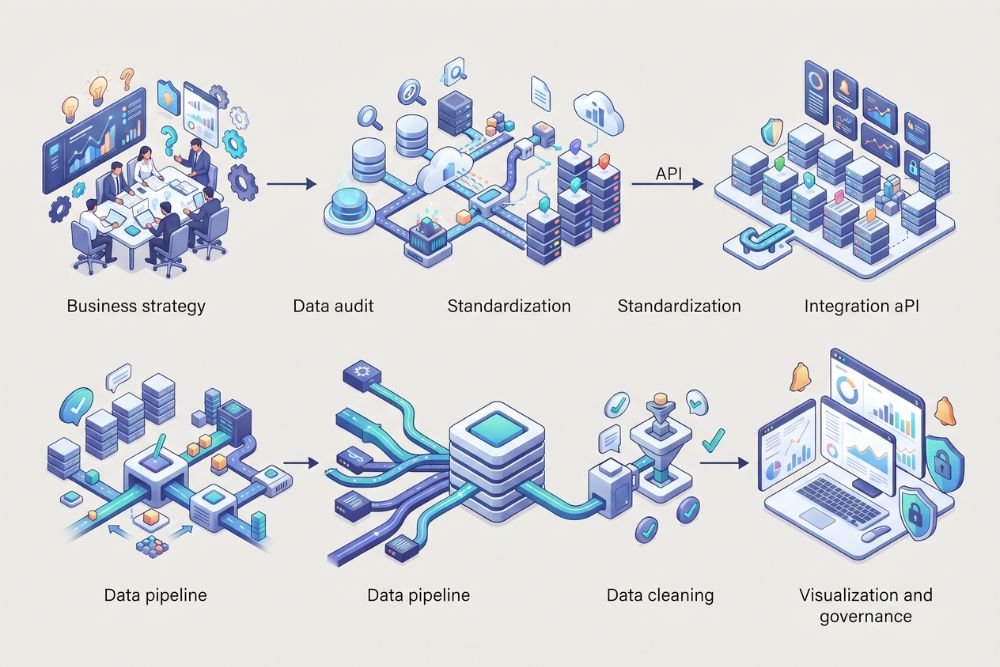
Follow this playbook in order. Each step builds on the one before it, so you avoid rework later.
Step 1: Start With Business Questions, Not Tools
Before you connect anything, write down the 5 to 10 questions your team needs answered. Examples: “Which channel has the lowest cost per qualified lead?” or “What is our true return on ad spend?” These questions decide which data you need and which KPIs matter.
Pro tip: If a data source does not help answer a business question, leave it out for now.
Step 2: Audit Every Data Source
List every platform that holds marketing data, who owns it, how often it updates and how you can access it (API, native connector or manual export). Most teams discover forgotten tools, duplicate accounts and gaps in tracking during this audit. That alone is a powerful win.
Step 3: Standardize Naming Conventions and UTMs
Messy campaign names are the silent killer of marketing data integration. Agree on one format for campaign names, UTM parameters, currencies, date formats and time zones. A simple rule such as channel_campaign_audience_month saves countless hours of cleanup.
Step 4: Choose the Right Integration Method
Pick the approach that fits your team size, budget and technical skills: native connectors, ETL/ELT tools, iPaaS automation, a customer data platform (CDP) or a custom API pipeline. The comparison table in the next section makes this decision easy.
Step 5: Connect Your Sources and Build the Pipeline
Start with your top 3 sources, usually ad platforms, GA4 and your CRM. Set up automated syncs on a schedule that matches how fast you make decisions (hourly, daily or weekly). Send everything to one central destination, such as BigQuery, Looker Studio or a data warehouse, so every report pulls from the same place.
Step 6: Clean, Deduplicate and Validate
Raw data is never ready to use. Remove duplicate records, merge customer identities across platforms, convert currencies and flag missing values. Then validate: compare your integrated totals against each platform’s native numbers. Small differences are normal, but large gaps signal a broken connection.
Step 7: Visualize, Automate and Govern
Turn clean data into dashboards that answer your Step 1 questions at a glance. Add automated alerts for sudden drops in spend, traffic or conversions. Finally, assign a data owner, document your definitions and review access and consent rules every quarter. Governance keeps your marketing data integration trustworthy long after launch.
Final Thoughts: Make Marketing Data Integration Your Edge

Marketing data integration is no longer a nice-to-have. It is the foundation of accurate attribution, faster decisions and every AI-powered tool you plan to use next.
Start small. Define your questions, audit your sources, standardize your naming and connect your top 3 platforms. Then build from there with clean, governed, automated data. Teams that do this stop arguing about whose numbers are right and start acting on the ones they trust.
Ready to unify your marketing data? At Panalinks, we help brands connect GA4, Google Tag Manager, ad platforms and CRMs into one reliable reporting system. Email us at contactus@panalinks.com to talk about your setup and get your marketing data working as hard as you do.