
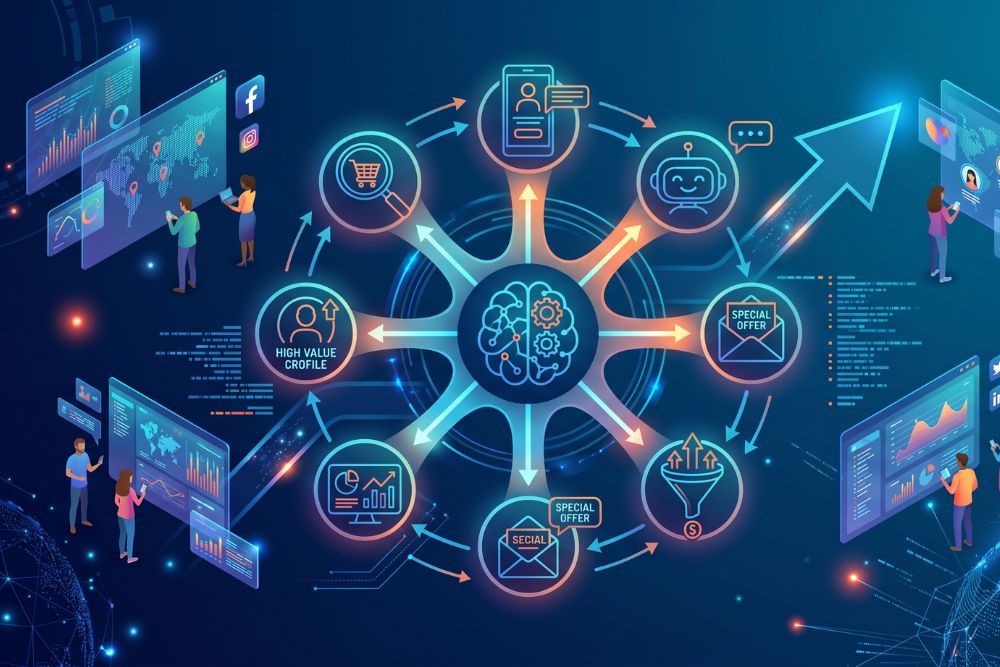
Did you know that businesses that use customer journey analytics, with AI plus Big Data kinda see up to 35% higher conversion rates and about a 25% drop in customer churn? In today’s hyper competitive digital world, understanding the exact way your customers move from first awareness to the purchase moment is not something you can just skip anymore. Honestly it’s one of the strongest competitive edges you can build in 2026.
In this guide, you’ll find out how AI powered customer journey analytics works, which tools lead the market, 7 tested strategies you can try right now, and actual examples that show the ROI in a real way. Whether you are a marketer, an analyst, or a business leader, this blog gives you a straight forward and doable path.
What Is Customer Journey Analytics Using AI?

Customer Journey Analytics Using AI is basically tracking, examining, and improving every interaction a customer has with your brand across every channel, plus each touchpoint. When it’s powered by Artificial Intelligence and Big Data, it stops being a static spreadsheet thing and becomes a sort of real time predictive intelligence engine.
Classic analytics mostly tells you what happened. AI powered customer journey analytics then goes further, it explains why it happened, predicts what will happen next, and even suggests what you should do about it automatically. It pulls data from your website, app, CRM, email, social media, and support operations and connects it into one unified view of each person.
Why It Matters More Than Ever in 2026

The modern customer journey is not totally linear. One buyer can touch your brand in six or more places before they even think about a purchase decision. With no AI, tying all those touchpoints together is basically impossible at scale. You end up with siloed data, delayed reporting , and segmentation that stays way too generic and brands quietly, miss conversion moments every single day.
When brands put money into AI-driven customer journey analytics, they are not just “optimizing” marketing. It becomes more like a full operational shift. They go from reactive to proactive, from one-size-fits-most outreach to more tailored personalization, and from decisions based on gut-feel to decisions that land with data-driven precision.
7 Proven Strategies for Customer Journey Analytics Using AI & Big Data

1. Build a Real-Time Unified Customer Data Platform
If you want AI-powered customer journey analytics, unified data is the baseline. A Customer Data Platform (CDP) pulls in information from every place your source website, mobile app, CRM, email, POS, and social media and it assembles a single, live customer profile. Then AI models layer on top of that unified dataset and surface patterns that a human analyst might not catch, or might catch way too late. Without this platform, the rest of the playbook tends to lose steam, and its value slips fast.
2. Use Predictive AI to Identify High-Intent Customers
Predictive analytics models, trained on historical big data, can score each customer’s chance to convert, buy more, or churn in real time. This gives sales and marketing teams a clearer path: work first on the people where the ROI is strongest. Top brands often say AI-powered predictive lead scoring lifts sales team efficiency by 30 to 50 percent, while close rates rise at the same time. Typically the model considers 200+ behavioral signals like pages visited, time on site, email open rates, and past buying history.
3. Map Every Micro-Moment With AI Journey Mapping
Old-school journey maps get made in workshops, mostly from assumptions, kind of like “we think customers do this” and then you hope. AI powered journey mapping, on the other hand, is generated from real behavioral data… millions of actual customer interactions, not the imaginary paths you expect. AI spots the most common routes, the biggest drop-off pockets, and the highest converting sequences so you can redesign the experience with pretty surgical, almost pinpoint accuracy.
4. Deploy NLP-Powered Sentiment Analysis Across All Touchpoints
Customer sentiment actually hides inside unstructured stuff: reviews, support tickets, social posts, and chat transcripts. Natural Language Processing (NLP) helps you read and analyze millions of those text interactions at scale. Teams that use sentiment analysis often say they notice unhappy customers earlier, like two to three weeks earlier, which gives them time to step in before churn shows up. This more proactive angle has been shown to recover about 15 to 20 percent of customers that were at risk.
5. Personalize at Scale Using AI-Driven Segmentation
Traditional segmentation usually gives you five to ten static customer groups, and then you’re stuck with them until the next refresh. AI driven micro-segmentation instead forms thousands of dynamic groups that update in real time from what people are doing right now. That’s how you get real one-to-one personalization, without losing your mind. McKinsey research says personalization at scale can return five to eight times the ROI versus generic campaigns. And yes, companies like Netflix, Spotify, and Amazon, they’ve basically built their growth engines on this same idea.
6. Implement Multi-Touch AI Attribution Modeling
First click and last click attribution models are kind of dead. They assign credit to one touchpoint while ignoring those eight to twelve other interactions that were actually part of the conversion story. Multi touch AI attribution takes the whole route into account, and it distributes credit across every touchpoint in the customer journey, so you get a real view into which channels and messages are truly driving revenue. With that kind of insight marketing teams can rebalance budgets and usually boost Return on Ad Spend by 20 to 30 percent, while keeping total spend stable.
7. Create Autonomous AI Feedback Loops for Continuous Optimization
Some of the most advanced brands moved beyond “just analysis” and into autonomous optimization, like they stopped waiting for insights to trickle in. AI systems keep testing learning, and updating changes across website content, email send times, ad creative , and even pricing in near real time, without needing a person to push every button. Every interaction generates data, that data trains the model, and then the model adjusts the next interaction. Early adopters often say their improvement rate is around ten times faster than teams stuck with manual A/B tests only.
Top Tools to Get Started in 2026
You do not need some huge budget to begin. Here are some widely used tools, grouped by category:
- Customer Data Platforms: Segment (Twilio), Adobe Experience Platform, Tealium
- Journey Analytics & Behavior: Heap, FullStory, Mixpanel, Amplitude
- Predictive AI & CRM: Salesforce Einstein, HubSpot AI, Zoho Zia
- Cross-Channel Engagement: Braze, Klaviyo, Iterable
- Attribution Modeling: Rockerbox, Triple Whale, Google Analytics 4 (Data-Driven)
Real-World Results: What Brands Are Achieving

A mid sized e-commerce brand rolled out AI based journey analytics to deal with a 78 percent cart abandonment rate , not just to “look at numbers”. They leaned on predictive intent scoring plus personalized re engagement sequences and somehow got a 41 percent lift in cart recovery. At the same time, customer acquisition cost dropped by 28 percent, and they pulled in more than 2 million dollars in recovered revenue during the first year.
A B2B SaaS platform took a slightly different path, using NLP sentiment analysis from support tickets, mixed with product usage signals to craft a near real time churn risk score per account. Then customer success teams got automated alerts about three weeks before the churn was expected to happen. The outcome was pretty strong: 33 percent less monthly churn and Net Revenue Retention moving from 104 percent up to 118 percent.
A regional bank also deployed AI journey analytics , mainly to surface cross sell and upsell opportunities on the fly. They combined four years of transaction data with digital behavior patterns. From that the AI produced next best product suggestions, which led to a 52 percent increase in average customer lifetime value across 24 months.
Conclusion
Customer journey analytics powered by AI and Big Data isn’t a nice to have anymore. It’s basically the new minimum requirement for competing in 2026 and beyond. If a brand can master it, they tend to out convert, out retain, and out scale their competitors. If they don’t, they end up “flying blind” while rivals make pinpoint decisions in real time.
In this guide you also get 7 strategies, and yes they are meant to be actionable. Begin with unified data, then add predictive intelligence, and personalize every touchpoint. After that build autonomous feedback loops so the customer experience gets smarter , day after day.
Now, pick just one of those strategies from the guide and commit to launching it within the next 30 days. That’s it. That’s how you start.
Ready to Transform Your Customer Journey?
If you felt this guide useful and kinda wanna see, how AI powered customer journey analytics could fit your own business, then our team at Panalinks is ready to help. We partner with brands to build, deploy, and grow those data driven customer experience strategies that actually show measurable results, not just promises.
So if you’re only beginning with analytics or you’re trying to level up what you already have in place, we’d genuinely like to know your aims and the obstacles you’re hitting.
Send us a quick email at contactus@panalinks.com, and let’s get the conversation going.