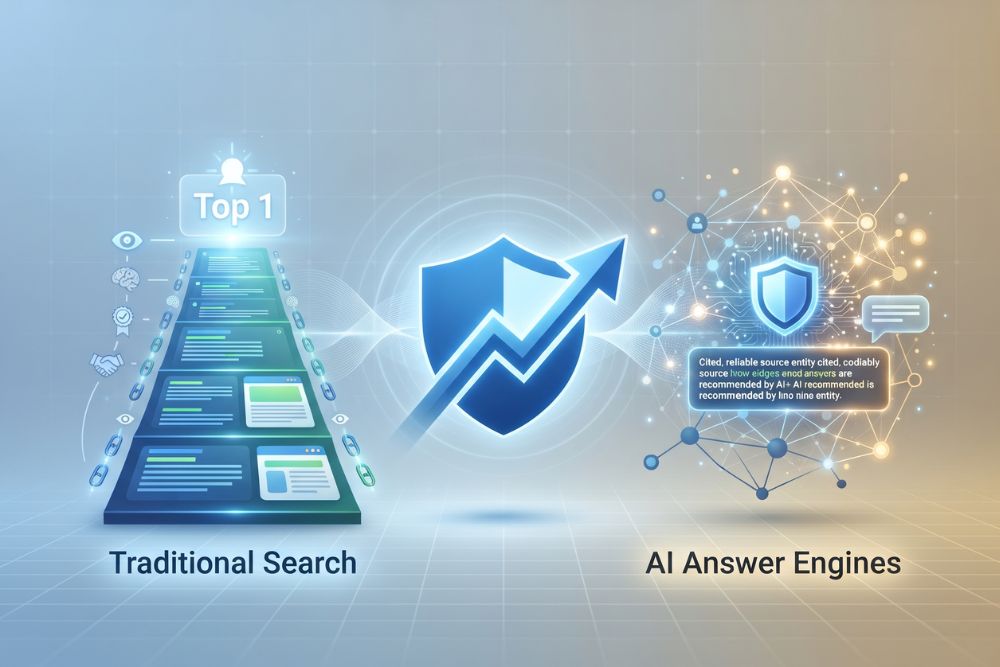
Brand authority SEO decides who gets the click, the citation and the recommendation, and it now does so in two places at once: the classic search results and the AI answers that sit above them.
Here is the uncomfortable truth. You can publish 100 blog posts, fix every technical error and still lose to a competitor whose name Google and AI assistants simply trust more.
That trust is not magic. It is built from authority signals: consistent, verifiable proof about who you are, what you know and who vouches for you, repeated across the web until machines and people stop doubting it.
In this guide you will discover 9 proven brand authority signals, how search engines and AI systems read each one, and a simple checklist you can start using today. Let’s build a brand that algorithms (and humans) cannot ignore.
Why Brand Authority SEO Matters More Than Ever in the AI Era

Search engines used to rank pages. Today they evaluate entities (brands, people and organizations), and AI assistants go one step further: they decide which entities are safe to quote.
Two shifts explain why this matters right now:
- Google rewards trust. Google’s guidance on creating helpful, people-first content centers on experience, expertise, authoritativeness and trustworthiness (E-E-A-T), and treats trust as the most important of the four.
- AI systems repeat what they recognize. Answer engines combine what they learned in training with what they retrieve live. Brands that are described clearly and consistently across reputable sources are easier for those systems to identify, trust and mention.
Here is how the game has changed:
| Comparison Dimension | Traditional Search | AI Answer Engines |
|---|---|---|
| What gets judged | Pages and links | Entities and individual passages |
| Main trust shortcut | Backlinks and E-E-A-T | Consistent mentions and citations |
| What winning looks like | A top ranking position | Being named or cited inside the answer |
The takeaway: authority is no longer a page-level trick. It is a brand-level asset that compounds every time another trusted source confirms who you are.
9 Proven Brand Authority SEO Signals Google and AI Systems Trust

Use these nine signals as your roadmap. Each one explains what it is, why it works for both search engines and AI assistants, and what to do this week.
1. A Clear, Consistent Entity Identity
Brand authority SEO starts with a simple question: can a machine tell exactly who you are? Your brand name, one-line description, logo, founders and category should read the same on your website, LinkedIn, Google Business Profile and every directory listing.
Why it works: Search and AI systems connect mentions to entities. Inconsistent details create doubt, and doubt means you get skipped.
Do this week: Write one sentence that defines your brand, then use it word for word on every official profile.
2. Organization Schema and sameAs Links
Structured data hands machines an unmistakable ID card. Add Organization schema with your name, logo, URL and sameAs links pointing to your official social and directory profiles, and add Person schema for your authors.
Why it works: It removes guesswork about which brand a page belongs to and which profiles are really yours.
Do this week: Add the markup (Rank Math’s Local SEO settings let you fill in organization details without code) and test it with Google’s Rich Results Test.
3. Original Research and Proprietary Data
Nobody can cite a statistic that only you have, unless they cite you. Publish a small survey, a benchmark from anonymized client work or a before-and-after case study with a clear method.
Why it works: Original data earns links from writers and gives AI answers a specific, attributable fact to quote.
Do this week: Pick one question your customers always ask, gather real numbers and turn the answer into a chart-led post.
4. Real Expertise: Author Pages and Credentials
Faceless content is forgettable content. Give every article a named author with a bio, credentials, past work and links to their professional profiles. Show first-hand experience too: screenshots, results, process notes and lessons learned.
Why it works: This is E-E-A-T made visible. It shows people, and the systems trained on how people judge quality, that a real expert stands behind the page.
Do this week: Build a proper author page for each contributor and link every post to it.
5. High-Quality Backlinks and Digital PR
Links from respected, relevant sites are still one of the strongest vouching signals on the web. Ten links from trusted publications in your industry beat a thousand from random directories.
Why it works: A backlink is a third party saying “this source is worth reading.” Brand authority SEO grows fastest when credible voices say it first.
Do this week: Pitch three editors or journalists with an original data point, an expert quote or a useful free tool, not a sales pitch.
6. Brand Mentions and Co-Citations
Your name appearing next to the leaders in your space, in roundups, podcasts, webinars and expert panels, builds association even when there is no link.
Why it works: AI systems learn from text, not only from hyperlinks. The more often reputable sources name you alongside the right topic, the more naturally you become part of that topic’s answer.
Do this week: Set up alerts for your brand name, then reach out to politely turn the best unlinked mentions into links.
7. Reviews, Testimonials and Social Proof
Star ratings, detailed client reviews and named case studies answer the question every buyer (and every algorithm) is asking: “Do real people trust this brand?”
Why it works: Reviews are fresh, specific and written by customers in their own words, which makes them a rich source of trust and context.
Do this week: Ask your five happiest clients for a detailed review on the platform your buyers actually use, and reply to every review you receive. Never buy or fake them.
8. Topical Authority Through Content Clusters
Stop publishing random posts. Pick the subject you want to own, build one in-depth pillar page, then surround it with 8 to 10 supporting articles that answer every related question and link back to the pillar.
Why it works: Depth tells search engines you are the go-to source on a topic, and it gives AI systems many clear, well-structured passages to pull from.
Do this week: Map your pillar and supporting topics on one page, then use internal links to connect them. Strong brand authority SEO is built on topical depth, not content volume.
9. Branded Search Demand and Community Presence
When people search for your brand by name, talk about you in communities and follow you on LinkedIn or YouTube, that is real-world recognition in action. Google has not confirmed branded search as a direct ranking factor, but it travels with every other signal on this list.
Why it works: Recognition drives mentions, mentions drive links and reviews, and AI systems often draw on public discussions to decide who the trusted names are.
Do this week: Share one genuinely useful insight per week on the channel where your audience already hangs out, and answer real questions in forums and communities without pitching.
How to Measure Your Brand Authority SEO Progress
Track these five numbers every month:
- Branded search impressions in Google Search Console
- Referring domains from relevant, trusted sites
- Review volume and average rating on your key platforms
- Brand mentions, linked and unlinked
- AI visibility: ask ChatGPT, Gemini and Perplexity the 10 questions your customers ask most, and note whether your brand is named or cited
3 Mistakes That Quietly Kill Brand Authority
- Chasing links without a story. Authority comes from being worth citing, not from buying placements.
- Inconsistent details. A different brand description on every profile splits your identity.
- Publishing without proof. Claims with no author, data or source give neither Google nor AI a reason to trust you.
Final Thoughts: Make Brand Authority SEO Your Unfair Advantage
Rankings can be copied. Content can be matched. But a trusted brand, one that Google, AI assistants and real people all recognize, is the hardest asset for competitors to replicate.
Start with identity, back it with proof, earn mentions from credible voices and keep showing up. Every signal in this guide strengthens the others, and brand authority SEO compounds month after month.
The brands that act now will be the names AI recommends tomorrow. Will yours be one of them?
Ready to Build Your Brand Authority?
Want a proven roadmap tailored to your business? Our team at Panalinks will audit your authority signals and show you exactly where to gain ground in search and AI answers. Email us at contactus@panalinks.com to book your free brand authority consultation today.