
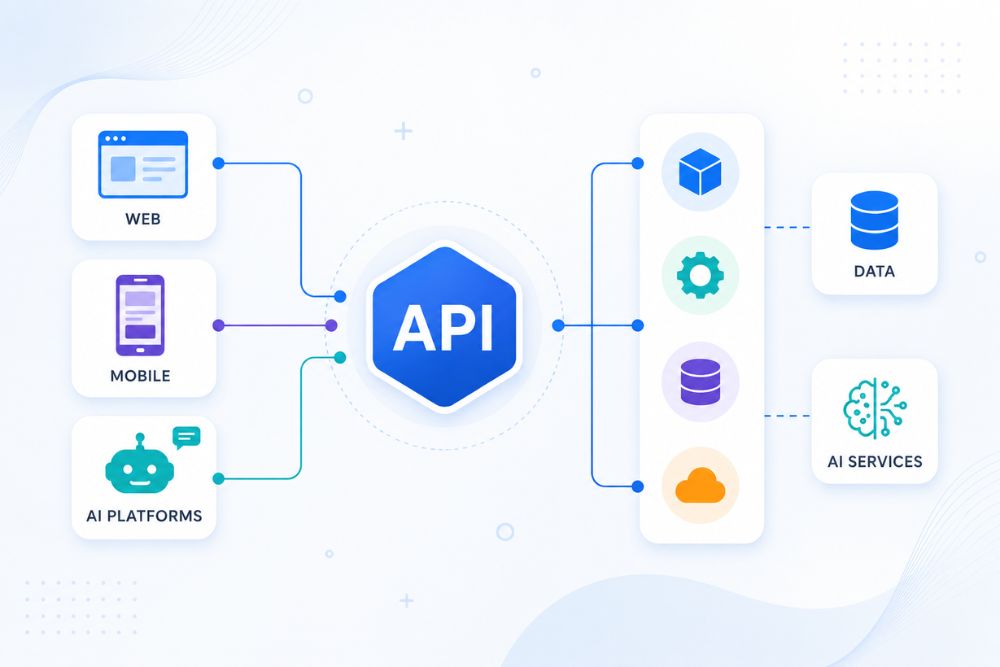
API driven development has moved from a backend buzzword to the core game plan behind how modern digital platforms are built, expanded, and shipped. Instead of stitching together monolithic systems and adding integrations later (kind of bolting things on after the fact ), teams now design the API first , treating it as the agreement, the product, and the growth throttle all at once.
In this guide, you’ll see what API driven development really means, why it’s blowing up in popularity, 7 proven benefits it brings, and a practical roadmap to apply it to your own projects.
What Is API Driven Development?
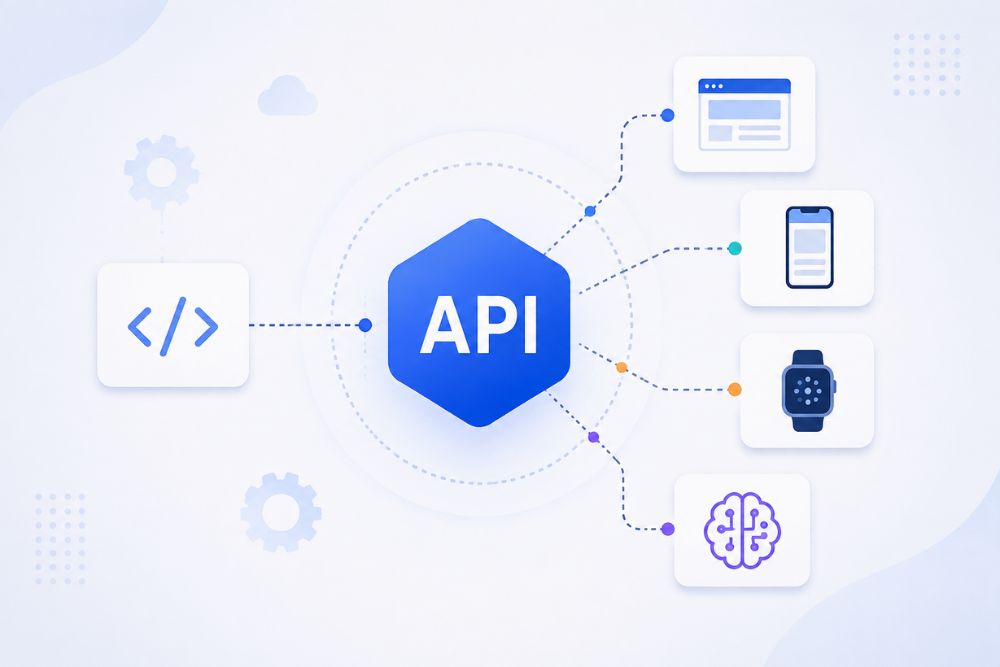
API driven development is a software design way where the Application Programming Interface (API) is created first before the frontend, before the database is locked in, and often before a single line of UI code is even written. The API becomes the single source of truth that every client (web app, mobile app, IoT device, or third-party collaborator) communicates with.
Think of it like sketching the house outline before pouring the foundation. Everyone architects, electricians, plumbers works off the same plan, even if they join at different times. In software, that “plan” is the API contract, and it keeps frontend teams, backend teams, and outside partners in lockstep.
Why API Driven Development Is Booming in 2026
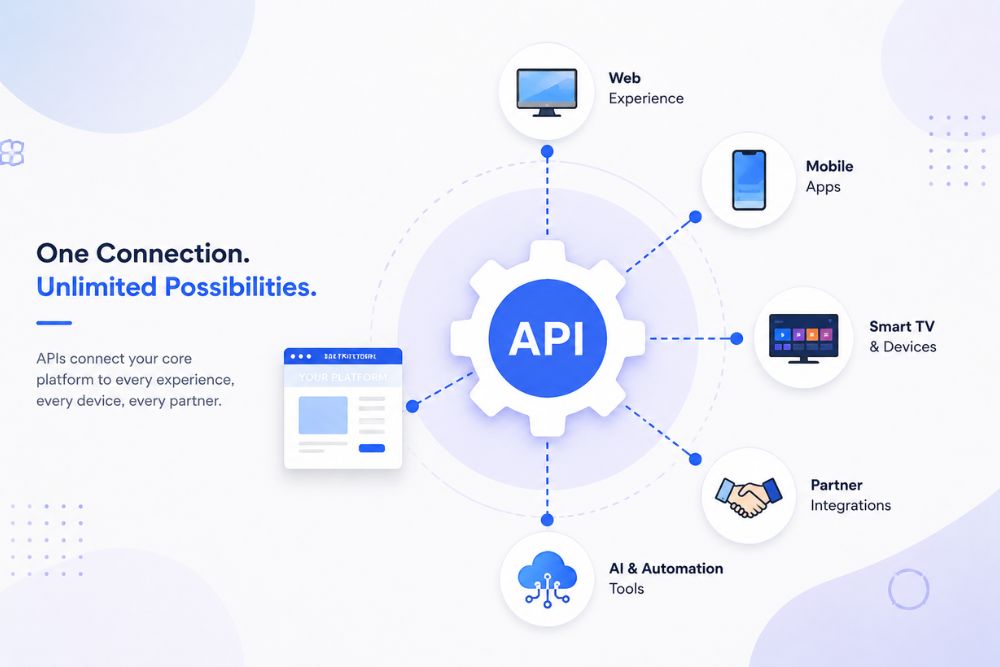
Digital platforms rarely stay in one corner today. A single product might power a website, a mobile app, a smart TV experience, and a partner connection at the same time. Here’s why this approach has become the default:
- Businesses need multi-channel delivery now web, mobile, wearables, and voice too and one carefully designed API can power all of it, without extra chaos.
- Microservices adoption is getting bigger by the day: teams split monoliths into independent services, but that only really works if they talk via clean, well documented APIs.
- The AI integration boom also matters, because models, chatbots, and automation tools typically connect to platforms almost exclusively through APIs, period.
- Faster time-to-market is a real thing here: when frontend and backend development run in parallel, release cycles shrink a lot, not a little.
- Plus, ecosystem and partner growth: companies increasingly treat their API like a product. They open it to partners, developers, and marketplaces, for fresh revenue streams and additional momentum.
7 Powerful Benefits of API Driven Development
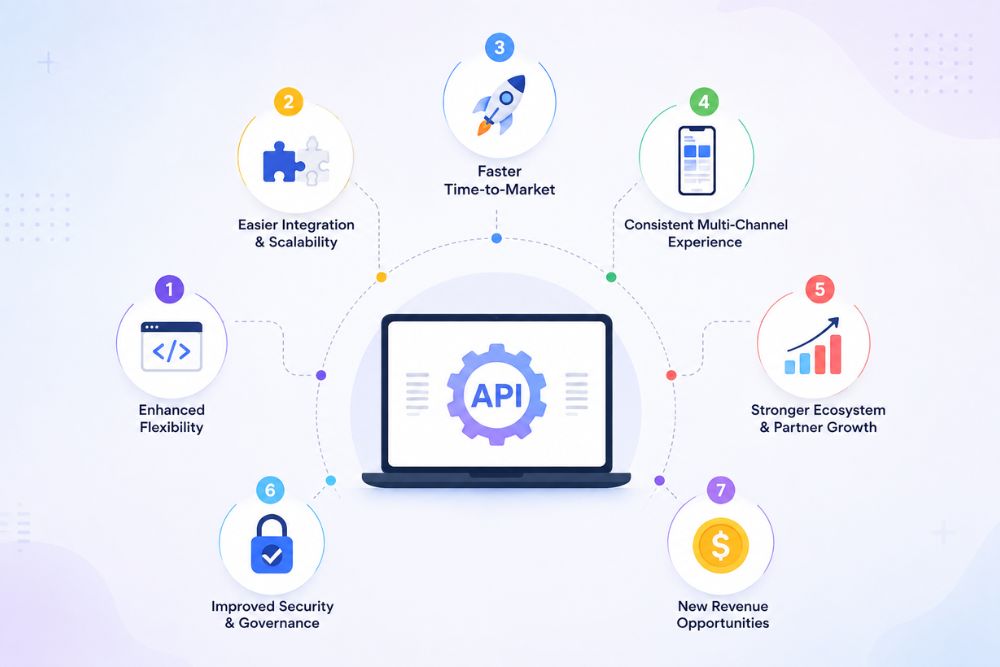
- Faster, Parallel Development
After the API contract gets defined, frontend and backend teams can work at the same time instead of waiting on each other so your sprints shorten significantly and delivery feels less painful, really. - Effortless Scalability
When each service maps to its own API, scaling becomes independent. So if you get a traffic spike on your checkout API, you don’t automatically have to scale the whole application with it. - Seamless Third-Party Integrations
Payment gateways, CRMs, analytics tools, and AI services can connect through clear endpoints. Instead of building custom, fragile links that break, you just integrate through the API. - Consistent Multi-Platform Experience
Whether the user is on iOS, Android, or the web, the same API provides identical data and business logic. This removes the weird inconsistencies across platforms that nobody wants to debug. - Stronger Security and Governance
Centralizing data access through APIs makes it easier to enforce authentication, rate limiting, and monitoring in one controlled layer, rather than trying to patch security everywhere at once. - Future-Proof Architecture
New channels, like a smartwatch app, a voice assistant skill, or an AI agent can plug into your existing API without touching your core system too much, like at all. It’s kind of the point, really. You build once , then you connect later. - New Revenue Opportunities
Companies such as Stripe, Twilio, and Google basically made entire businesses by exposing their core functionality as public APIs, turning infrastructure into a real product instead of just “internal stuff”.
API Driven Development vs. Traditional Development: Key Differences
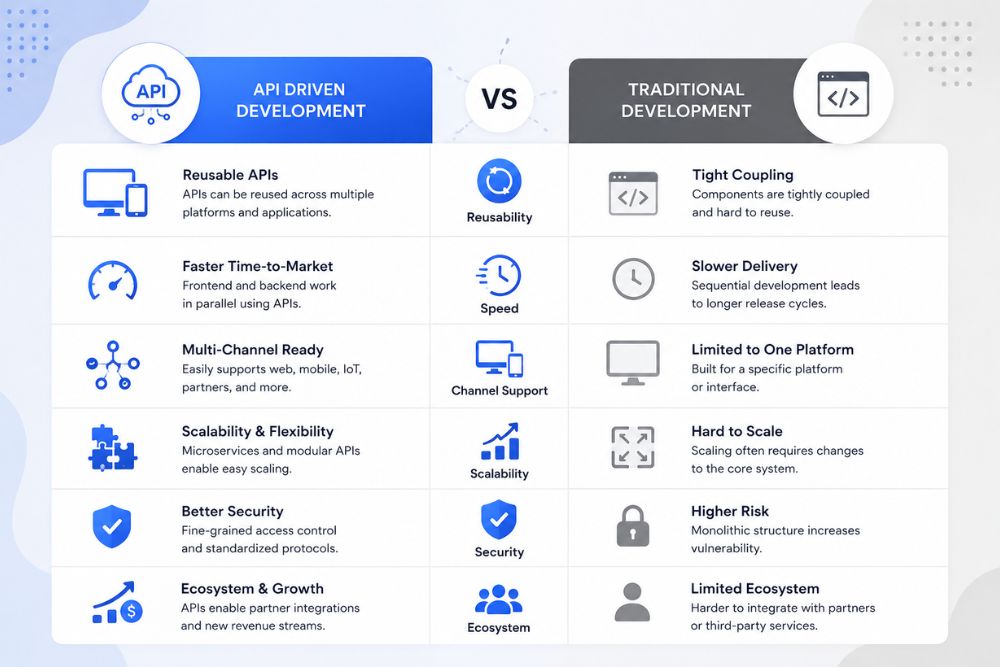
- Design order: API-first tends to think about the interface first, before UI traditional development often builds UI first, then kind of backtracks to retrofit an API.
- Team workflow: API-first lets teams work in parallel, whereas traditional development is more sequential, like step by step.
- Integration readiness: API-first platforms are integration-ready from day one; traditional platforms usually need rework to expose data externally, and that can get messy.
- Scalability: API-first supports scaling per service, independently, while traditional monoliths scale as one big unit, not great for tuning.
Real-World Examples of API Driven Development
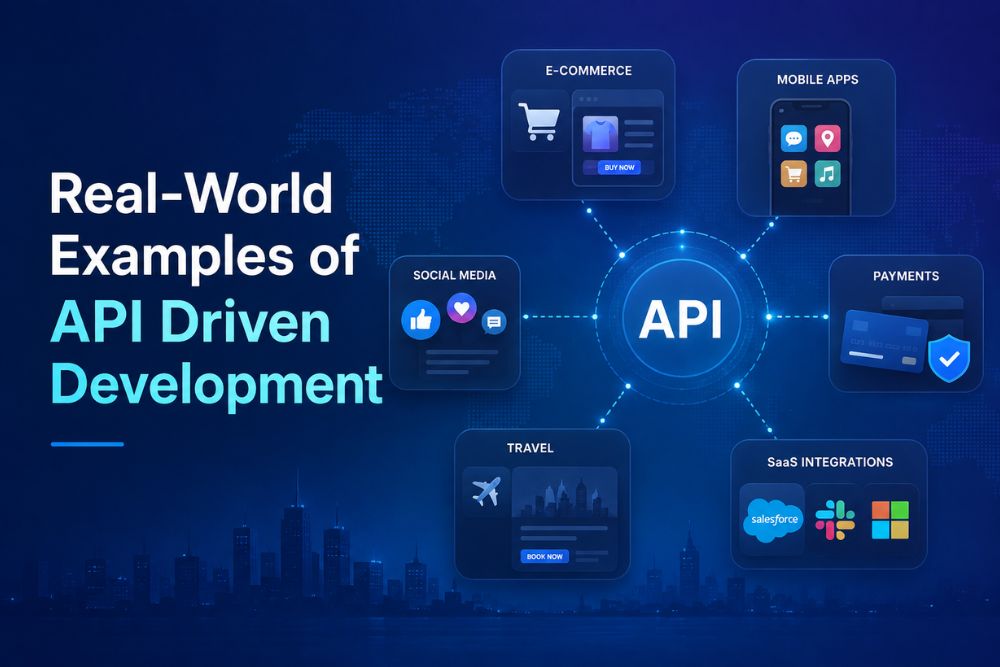
Stripe built its payments business around a clean, well-documented API, so developers can integrate in minutes, not weeks.
Twilio took telecom infrastructure, things like SMS voice, and video and translated it into simple API calls, then powered thousands of apps.
Shopify exposes storefronts, inventory, and checkout through APIs, which makes headless commerce and custom storefronts way more realistic.
Google Maps Platform, a single API set powers navigation, ride-sharing, delivery, and even real estate apps world wide.
6 Essential Steps for an API driven development approach
Start with the contract first, use OpenAPI/Swagger to sketch endpoints, request/response formats and those tricky error states too, before any real code shows up.
Design for consumers not only the data model, build the API around what client apps actually require, rather than what your database schema thinks is best.
Version it from day one, add /v1/ , /v2/ paths or go with header-based versioning so later changes do n’t silently wreck older integrations.
Lock down every single endpoint, implement authentication (OAuth2/JWT), rate limiting, and input validation as non negotiables, like seriously.
Document like it matters, auto generate interactive docs (Swagger UI, Postman collections) so partners can self serve with less back and forth.
Monitor then iterate, keep an eye on latency, error ratios, and usage patterns so the API keeps getting smoother over time.
Common Challenges in API driven development (and how to fix them)
Challenge: Over engineering too early
Fix: Begin with a lean, versioned API that covers the key use cases only, then expand based on what real consumers ask for.
Challenge: Documentation that falls short
Fix: Treat documentation like a deliverable product, not some after thought, and generate it automatically from the API schema.
Challenge: Breaking changes
Fix: Use firm versioning rules plus clear deprecation windows, and make sure consumers hear about it well in advance.
Challenge: Security gaps popping up
Fix: Put authentication, throttling, and logging in place from the first endpoint, not after a breach has already happened.
The Future of API Driven Development
With AI agents, IoT devices , and automation tools multiplying, APIs are getting closer to the universal language that machines use to talk to each other. Expect deeper adoption of GraphQL for more flexible data fetching, event-driven APIs (webhooks, streaming) for real time platforms, and AI assisted API design tools that kinda generate and validate endpoints automatically. The companies that can really master API driven development now are basically setting up the infrastructure that will power tomorrow’s AI native applications.
Ready to Build a Scalable API-Driven Platform?
Turn your digital product idea into something scalable , secure, and integration ready with the right API architecture. Reach out to our development team so we can talk about your project, API strategy, or modernization needs.
Email us: contactus@panalinks.com
Let’s build a platform that’s ready for today’s users, and also for tomorrow’s technologies.
Conclusion: Why API Driven Development Is No Longer Optional
Modern digital platforms live across a bunch of channels all at once, and API driven development is the only approach that’s flexible enough to keep up. From quicker releases to better security, plus extra revenue streams, the advantages build up the earlier you adopt it. If you’re planning your next platform , digital product, or AI integration, start with the API , everything else grows faster from there.