

Every second your data sits unprocessed is a decision made without evidence, kinda, you know. Businesses that still lean on batch reporting are basically dealing with yesterday’s problems while competitors are moving on what is happening right now. That’s really the promise of AI data pipelines: they turn an always on stream of raw information into instant, usable intelligence, and they do it on repeat, automatically, continuously, and at scale, not as a one time chore.
In this guide you’ll see how AI data pipelines work, why they’ve turned into a must have for real time decision making, and 7 proven strategies to build one that actually delivers outcomes instead of turning into another over engineered attempt that gets stuck in development.
What Are AI Data Pipelines?

An AI data pipeline is an automated system that pulls data from multiple sources, tidies and reshapes it, routes it into machine learning models, and produces insights or predictions with little to no hands-on effort. Compared with traditional ETL (Extract, Transform, Load) pipelines, which are mostly meant to move and organize data, AI data pipelines are meant to work alongside the data itself, spotting irregularities, estimating results, and launching actions as new information shows up.
The gap between a traditional pipeline and an AI powered one, is mostly about timing and “smarts”. A traditional pipeline might refresh a dashboard once a day. An AI data pipeline updates a fraud score the moment a transaction happens, like, immediately.
Why Real-Time Insights Matter More Than Ever

Markets move, fast , customer expectations change overnight, and operational risks compound in minutes , not months. Real time insights give teams a real competitive edge, because they reduce the gap between something that happens and the business actually reacting to it.
- Faster fraud detection ,that stops losses before they happen, not after
- Dynamic pricing engines that tune to demand within seconds
- Personalized customer experiences that respond to live behavior
- Predictive maintenance that spots equipment failure before it shows up
- Supply chain visibility that adapts to disruptions, instantly
7 Proven Strategies for Building High-Performing AI Data Pipelines
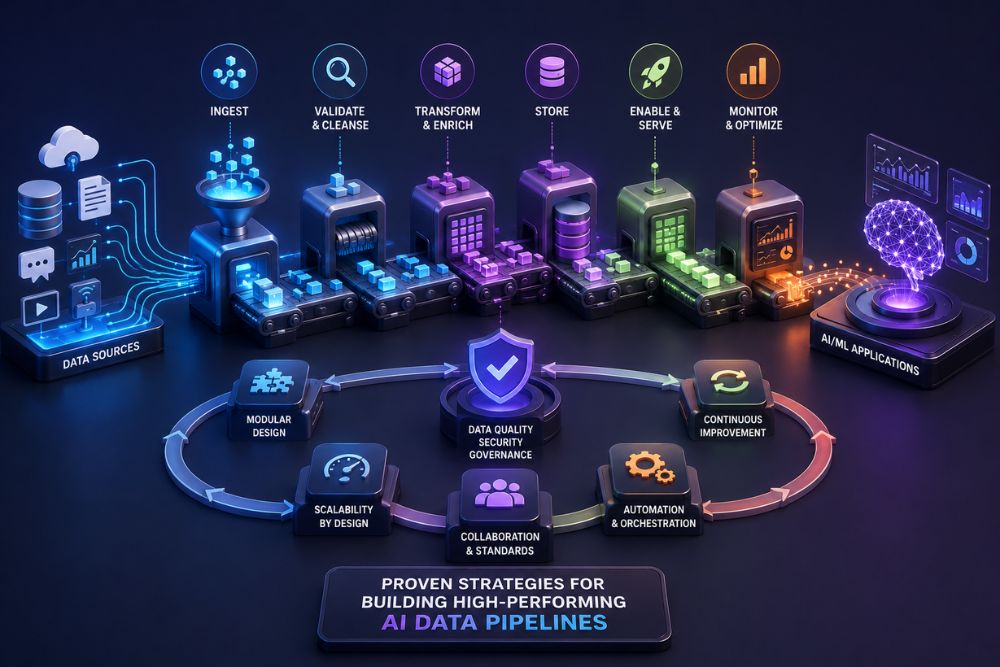
1. Start With a Clear business outcome, not a tech stack
The biggest mistake teams make is picking tools before they define the decision the pipeline is supposed to support. Start by asking what action should change as soon as new data arrives. If you can’t answer that question, clearly and specifically, the pipeline will just collect data endlessly, without creating any kind of value.
2. Pick streaming over batch wherever latency matters
Tools like Apache Kafka, Amazon Kinesis, and Google Pub/Sub help data move continuously, instead of sitting in scheduled chunks. A streaming architecture is what makes true real time insights possible, because it removes the waiting window that batch processing always adds.
3. Put data quality checks right into the pipeline
An AI model is only as dependable as the data feeding it. Automated validation, deduplication, and schema checks should run inline, not as some separate cleanup step after everything is already moving. Bad data moving fast is still bad data… it just causes harm faster.
4. Use Feature Stores so Models Stay Consistent
A feature store kind of centralizes the exact inputs your models lean on, so that the same calculation used during training also shows up in live production. This one tweak stops a very common reason AI pipelines fail, models that act differently in production than they did in testing.
5. Build for Horizontal Scalability from the start
Real time systems get weird volume spikes, sometimes very suddenly. If you go with containerized, cloud native architecture like Kubernetes, or you use serverless functions, your pipeline can scale up when demand surges and then scale down again when things calm down, so infrastructure costs don’t quietly spiral.
6. Add Monitoring and Alerting for the Pipeline Itself
It’s not enough to just monitor the business metrics that come out of the pipeline. You also need to watch pipeline health directly: data freshness, processing latency, model drift, and error rates. A silent failure in a real time system can slide by unnoticed for hours, and slowly erode trust in every insight it produces, over and over.
7. Automate the Feedback Loop
The strongest AI data pipelines don’t only spit out insights… they learn from what happens next. Feeding results back into model retraining helps keep predictions sharp, as customer behavior and market conditions shift, instead of letting accuracy decay slowly over time.
Common Challenges When Implementing AI Data Pipelines

Common hard challenges when implementing AI data pipelines
- Data silos across different departments that keep you from getting one real time view, all together
- Legacy systems that were never, really designed to stream data continuously
- Model drift as customer behavior changes over time, slowly but surely
- Underestimating the actual cost of keeping infrastructure running at scale
- Skills gaps between data engineering people and machine learning teams
None of these challenges are a reason to skip an AI data pipeline, they’re more like reminders to plan the architecture first, before writing a single line of code and then patching later.
How Businesses Are Using AI Data Pipelines Today

Retailers are using real time pipelines to tweak inventory recommendations the moment a product starts trending.
Financial institutions score transaction risk in milliseconds, not by waiting for nightly fraud reports. Manufacturers pipe sensor data straight into predictive maintenance models, which cuts unplanned downtime by a lot. Marketing teams tailor website experiences based on live visitor behavior, instead of yesterday’s session kind of thing.
Across nearly every industry, the pattern is pretty clear: businesses that act on real time insights are moving faster, while the others are stuck waiting on the next scheduled report.
Final Thoughts
AI data pipelines are not really a luxury thing only for tech giants anymore. If you have the right kind of architecture it’s actually possible for a growing business to do it, and move away from reactive reporting into more proactive, almost real-time decision making. The ideas above are a decent place to start, yet it’s in the execution part where projects tend to either work ,or quietly fall apart.
So if your organization wants to turn raw data into real-time insights, our team at Panalinks can assist you. We can help you design, build, and scale an AI data pipeline that fits your existing systems plus your goals. Get in touch with us at contactus@panalinks.com to start the conversation .